
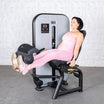
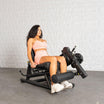
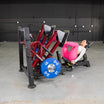

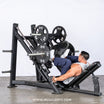




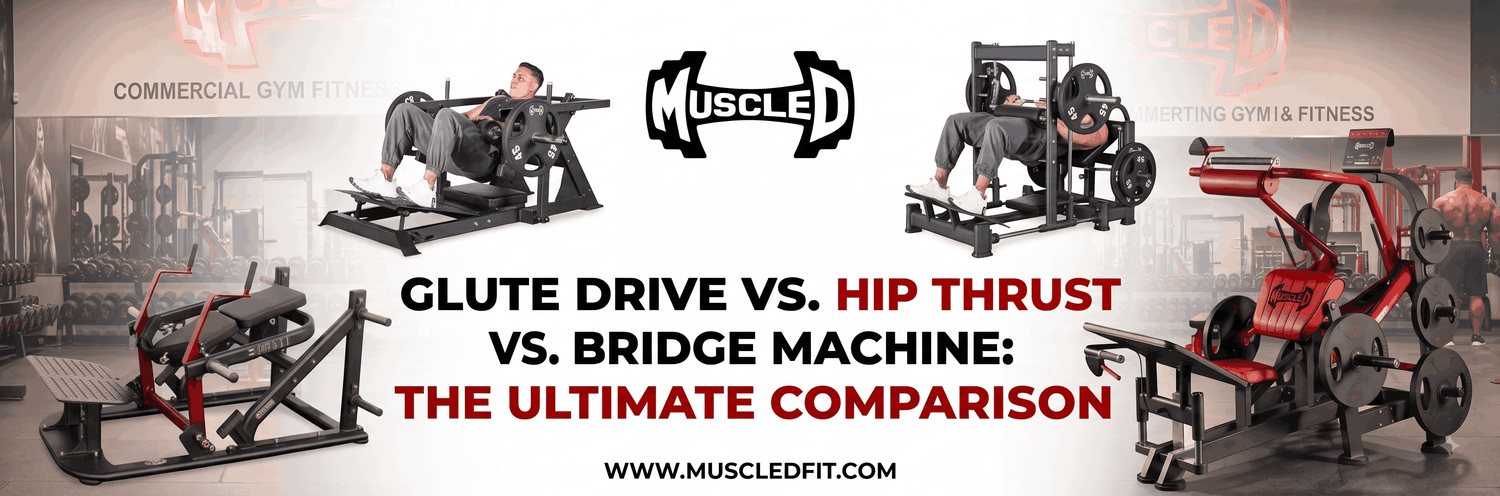
Whether you are equipping a commercial gym, designing a specialized athletic facility, or upgrading your personal studio, glute-building equipment has become non-negotiable. Lower-body training has evolved beyond standard squats and deadlifts, with targeted glute machines taking center stage.
Fitness equipment terminology can get confusing. Terms like Glute Drive, Hip Thrust Machine, and Glute Bridge Machine are frequently used interchangeably, yet they offer distinct biomechanical profiles, ranges of motion (ROM), and resistance curves.
Understanding these differences, backed by exercise science, will help you choose the right equipment for your facility and client goals.
The Science Behind Horizontal Glute Training
Traditional compound lifts like squats and deadlifts apply force along a vertical vector. While essential for overall development, vertical exercises peak in load when the glutes are stretched and offer lower muscle activation at full lockout.
Research by Dr. Bret Contreras et al. (2015) demonstrated that horizontal hip extension exercises elicit significantly greater mean (69.5% vs. 29.4%) and peak (172% vs. 84.9%) gluteus maximus EMG activity compared to back squats.
Furthermore, horizontal loading takes advantage of active insufficiency of the hamstrings—because the knees remain bent at roughly 90 degrees, the hamstrings are shortened, forcing the gluteus maximus to carry the primary burden of extension.
1. The Glute Drive Machine
What It Is
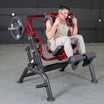
A Glute Drive machine replicates a belt-loaded hip thrust in a fixed, highly stable unit. Instead of balancing a heavy barbell across the pelvis, the lifter secures themselves using an adjustable waist belt/harness system.
Biomechanical Characteristics
- Load Path: Constant tension along an arc using a padded belt mechanism.
- Back Support: Elevated, pivoting, or fixed padded backrest positioned at shoulder blade level and supporting the hips.
- Range of Motion: Full ROM, allowing deep hip flexion at the bottom and full hip lockout at the top.
Key Benefits
With no barbell to balance or pad to adjust, users experience superior pelvic comfort and stability. This allows lifters to safely train to failure with heavy loads without loading pressure onto the spine or hips.
Featured Model

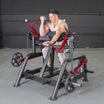
- Muscle D Pro Strength Hip Thruster — Belt-based design delivers direct, isolated glute engagement while eliminating setup friction.
2. The Hip Thrust Machine
What It Is
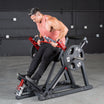
A Hip Thrust machine uses a leverage arm, guided path, or multi-axis track system to move an external load through hip extension. Unlike the Glute Drive, leverage and Smith-style hip thrusters typically employ a rigid pad or guided bar system rather than a soft wrap belt.
Biomechanical Characteristics
- Range of Motion: High total displacement (vertical and horizontal).
- Movement Duration: Studies show hip thrusts feature a longer concentric phase (~0.8 sec) vs. glute bridges (~0.58 sec), supporting strength development across a longer path of motion.
- Vector Path: Leveraged or guided arc that accommodates deep hip stretch at the start.
Key Benefits
Leverage and guided hip thrust machines excel at building full-spectrum strength and hypertrophy across the entire rep path. They allow users to work through maximum ROM, stretching glute fibers under load before driving into full extension.
Featured Models


- Muscle D Excel Leverage Hip Thruster — Smooth leverage pivot that tracks natural hip movement with easy loading.
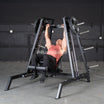
- Muscle D Excel 3D Smith Machine Hip Thruster — Combines guided linear and multi-directional freedom for custom movement paths suited to any body proportion.
3. The Glute Bridge Machine
What It Is
A Glute Bridge machine positions the user closer to the floor with lower or flat upper-body support—distinct from the elevated backrest position of a hip thrust machine.
Biomechanical Characteristics
- Range of Motion: Shorter, focused ROM.
- Force Profile: Peak force concentrated at terminal hip extension (lockout).
- Kinematics: Research (Journal of Human Sport and Exercise) shows hip thrusts produce nearly double the vertical displacement (~35.6 cm vs. ~15.4 cm), while glute bridges allow higher force production at lockout where the glutes are at their shortest muscle length.
Key Benefits
The Glute Bridge machine is ideal for targeting peak contraction at the top of the lift, rehabilitating hip mechanics, or training athletes who need maximum power at full extension (e.g., sprinting lockout). Its reduced ROM and stable base also make it exceptionally beginner-friendly.
Featured Model

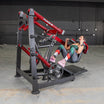
- Muscle D Plate Loaded Glute Bridge Hip Thruster Machine — Grounded base setup with heavy plate-loading capability for safely overloading terminal hip lockout.
Summary Comparison
| Feature | Glute Drive Machine | Hip Thrust Machine | Glute Bridge Machine |
|---|---|---|---|
| Primary System | Belt / Harness | Leverage Arm / Guided Bar | Flat/Lower Platform Lever |
| Range of Motion | Full ROM | Full ROM | Partial / End-Range ROM |
| Peak Resistance Point | Continuous throughout | Bottom stretch to peak contraction | Terminal Lockout |
| Pelvic Comfort | Highest (Belt strap) | High (Padded bar/pad) | High (Padded hip bar) |
| Primary Goal | Hypertrophy & heavy isolation | Hypertrophy & full-ROM power | Lockout power & glute isolation |
Which Machine Should You Choose?
- Choose a Glute Drive (Pro Strength Hip Thruster) if you want a user-friendly belt system that minimizes setup time and maximizes pelvic comfort for heavy hypertrophy work.
- Choose a Leverage Hip Thrust Machine (Excel Leverage Hip Thruster or Excel 3D Smith Machine) if you want maximum mechanical variety, full ROM development, and guided leverage loading.
- Choose a Glute Bridge Machine (Plate Loaded Glute Bridge) if your focus is end-range lockout strength, athletic sprint power, or offering an approachable option for beginners.
By providing the right tool for the job, you ensure safer setups, better glute activation, and superior results for your members and athletes.
References
- Contreras, B., Vigotsky, A. D., Schoenfeld, B. J., Beardsley, C., & Cronin, J. (2015). A Comparison of Gluteus Maximus, Biceps Femoris, and Vastus Lateralis Electromyographic Activity in the Back Squat and Barbell Hip Thrust Exercises. Journal of Applied Biomechanics, 31(6), 452–458.
- Contreras, B., et al. (2011). Biomechanical methods to measure gluteus maximus activation during hip extension exercises. Journal of Strength and Conditioning Research.
- García-Sánchez, A., et al. (2020). Biomechanical differences between hip thrust and glute bridge for hip extensors. Journal of Human Sport and Exercise / UCAM Research.

Leave a comment
All comments are moderated before being published.
This site is protected by hCaptcha and the hCaptcha Privacy Policy and Terms of Service apply.