







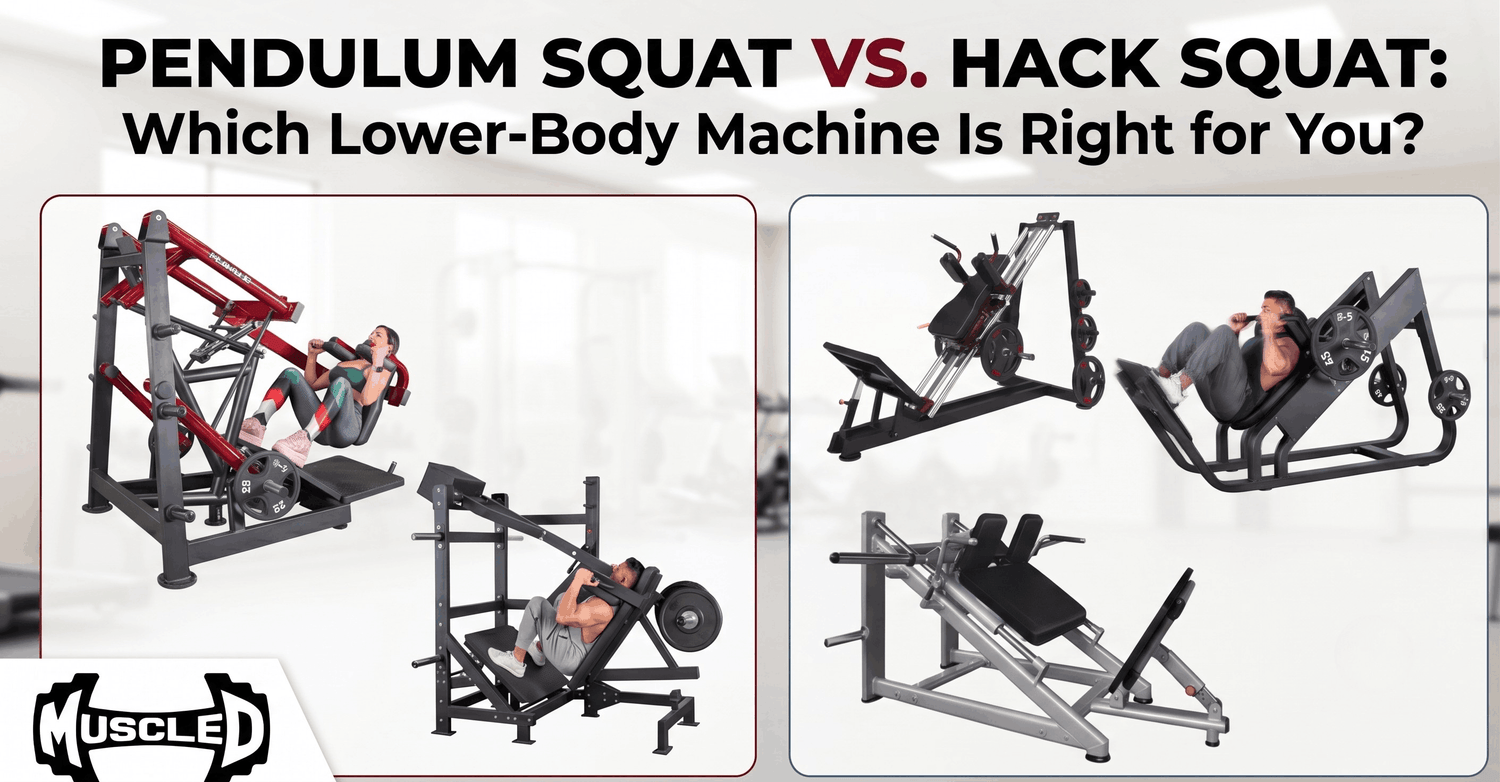
Pendulum Squat vs. Hack Squat: Which Lower-Body Machine Is Right for You?
When it comes to building serious leg size, strength, and lower-body power, fixed-motion machines allow lifters to push to absolute muscular failure without a spotter, a fallen barbell, or spinal fatigue cutting the set short.
Two of the top contenders in machine-based leg training are the Pendulum Squat and the Hack Squat. Both are built to destroy your lower body—but they operate on entirely different biomechanical principles, resistance curves, and movement paths. Understanding those differences will help you choose the right machine for your goals, joint health, and facility.
The Core Difference: Arc vs. Line
- Hack Squat: Moves along a rigid, straight track (typically 30–45 degrees). Resistance is linear, making the bottom of the movement—deep knee flexion—the hardest point of the lift.
- Pendulum Squat: Moves along a curved arc on a pivot system that mimics a free-weight squat. A counterbalanced leverage system eases the load at the bottom and increases resistance as you drive toward full extension.
The hack squat excels at isolating the quadriceps under extreme stretch. The pendulum squat delivers a more balanced load across the entire lower body—quads, glutes, and hamstrings—while being exceptionally joint-friendly.
At-a-Glance Comparison
| Feature | Pendulum Squat | Hack Squat |
|---|---|---|
| Movement Path | Curved arc (swinging pivot) | Straight, linear track |
| Hardest Point | Mid-to-top of the rep | Extreme bottom (deep flexion) |
| Primary Muscles | Quads, glutes, hamstrings | Quadriceps isolation |
| Joint Impact | Very low—knee & back friendly | High knee flexion & joint loading |
| Loading Capacity | Lower absolute weight (feels heavier via leverage) | Very high absolute weight capacity |
| Ankle Mobility Needed | Low (arc accommodates tight ankles) | Moderate-to-high dorsiflexion required |
The Pendulum Squat
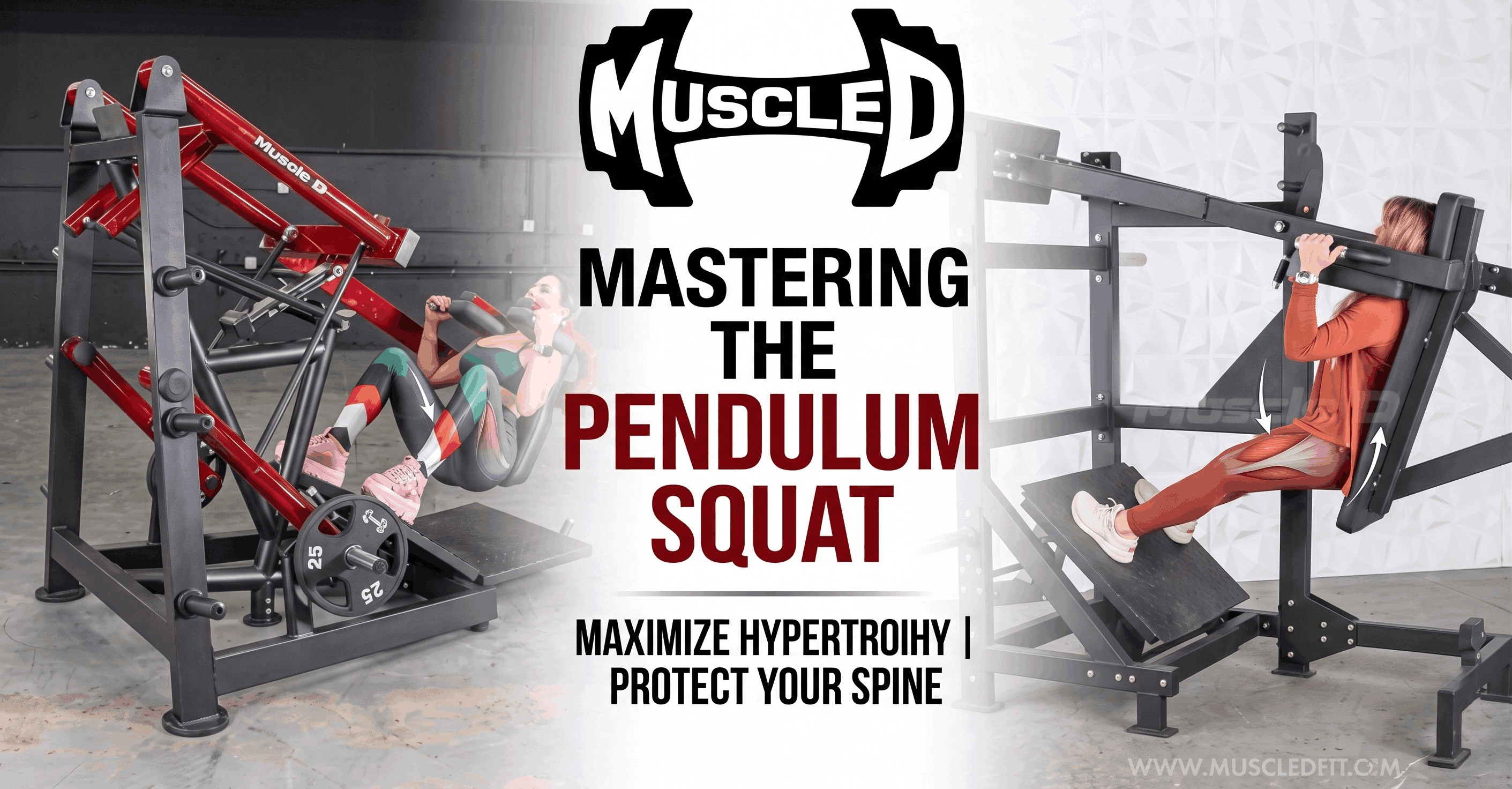
The pendulum squat uses an arced pivot with a counterbalanced system. As you descend, mechanical advantage shifts to ease the load at your weakest point (deep knee flexion), then increases resistance as you drive upward—matching the natural ascending human strength curve.
Research in exercise biomechanics (Clark et al., 2012) confirms that squat sticking points occur near the bottom due to disadvantageous moment arms at the hip and knee. The pendulum squat directly addresses this, letting you train closer to true mechanical failure without getting pinned in the hole. The swinging arc also requires significantly less ankle dorsiflexion.
Key Benefits
- Natural Strength Matching: Gets heavier as you stand, maximizing tension where you’re biomechanically strongest.
- Knee & Lower Back Support: Reduces shear stress at peak knee flexion—ideal for athletes with prior knee injuries or lower back fatigue.
- Full Lower-Body Hypertrophy: High recruitment across quads, adductors, and gluteus maximus throughout the arc (Nunes et al., 2022).
Featured Muscle D Pendulum Squats
-
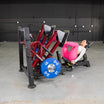
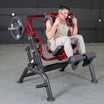
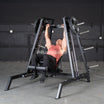
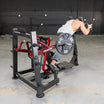
Excel Counterbalanced Pendulum Squat: Built for commercial gyms and serious home gym owners. Features an ultra-smooth counterbalanced leverage arm for seamless arc transitions, protecting your lower back while maximizing lower-body engagement.

Excel Counterbalanced Pendulum Squat — Muscle D Fitness -
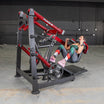
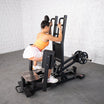
Power Leverage V2 Pendulum Squat: Engineered for heavy-duty commercial use with adjustable footplate angles and an ergonomic shoulder pad assembly that accommodates lifters of all heights with zero joint pinch.

Power Leverage V2 Pendulum Squat — Muscle D Fitness
The Hack Squat
The hack squat locks your torso against an angled, padded carriage running on precision linear bearings. Because your back is secured to the sled, you don’t need to balance the load or engage your spinal erectors to stay upright—all torque goes to the quads.
Studies on linear motion squat devices (Abelbeck, 2002) show that fixed-track hack squats shift torque almost entirely to the knee joint when feet are placed in line with or slightly forward of the hips. This creates maximal stretch on the quad muscle fibers. Recent research on lengthened-partial hypertrophy (Pedrosa et al., 2022) indicates that training muscles under high tension at long lengths triggers superior hypertrophy—making the hack squat arguably the single best quad-building tool available.
Key Benefits
- Maximum Quad Hypertrophy: Directs nearly all movement torque into knee extension for unrivaled quad sweep development.
- Zero Core/Spinal Fatigue: Back support removes lumbar stress, allowing you to take quad sets to complete muscular exhaustion safely (Clark & Lambert, 2010).
- Massive Loading Capacity: Smooth track mechanics allow lifters to safely handle very high absolute loads.
Featured Muscle D Hack Squats
-
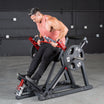
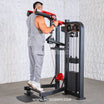
Excel Linear Hack Slide: Linear bearings and heavy-gauge steel construction deliver an ultra-smooth glide that isolates the quadriceps with surgical precision.

Excel Linear Hack Slide — Muscle D Fitness -
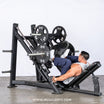
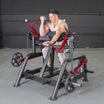
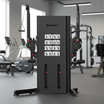
Power Leverage V2 45-Degree Hack Squat: The classic 45-degree hack squat with an oversized non-skid footplate and heavy-duty locking handles. Adjust foot placement to shift focus between the vastus lateralis, glutes, or teardrop (vastus medialis).

Power Leverage V2 45-Degree Hack Squat — Muscle D Fitness -
30-Degree Linear Hack Squat Machine: A flatter 30-degree incline that reduces shear pressure on the knees while maintaining intense quad isolation—ideal for athletes needing high quad stimulus with less direct joint compression.

30-Degree Linear Hack Squat Machine — Muscle D Fitness
Which Should You Choose?
Choose a Pendulum Squat if:
- You have knee or lower back issues: The counterbalanced arc lifts load out of the bottom hole, preserving knee cartilage and patellar tendons.
- You want total lower-body development: Target glutes, hamstrings, and quads in a single compound movement.
- You lack ankle mobility: The arced path accommodates tight ankles without sacrificing squat depth.
- Top Pick: Excel Counterbalanced Pendulum Squat
Choose a Hack Squat if:
- Your goal is maximal quad hypertrophy: Build outer quad sweep and teardrops through heavy mechanical tension at long muscle lengths.
- You want high loading capacity: Push massive weights along a stable, fixed linear track.
- You want to eliminate spinal stabilization: Your back or core fatigues early during free-weight squatting.
- Top Pick: Power Leverage V2 45-Degree Hack Squat
Final Verdict
Both machines deserve a place in any high-performance training facility. For absolute quadriceps isolation and maximum stretch hypertrophy, a linear hack squat like the Excel Linear Hack Slide or 30-Degree Linear Hack Squat is unbeatable.
For a natural movement curve, complete leg hypertrophy, and long-term knee and lower back health, a counterbalanced unit like the Power Leverage V2 Pendulum Squat is a game-changer.
Ready to take your lower body training to the next level? Explore Muscle D Fitness’s full line of commercial leg machines today.
Scientific References
- Abelbeck, K. G. (2002). Biomechanical model and evaluation of a linear motion squat type exercise. Journal of Strength and Conditioning Research, 16(4), 516–524.
- Clark, D. R., Lambert, M. I., & Hunter, A. M. (2012). Muscle activation in the loaded free barbell squat and machine hack squat. Journal of Strength and Conditioning Research, 26(4), 1169–1205.
- Nunes, J. P., et al. (2022). A brief review on the effects of the squat exercise on lower-limb muscle hypertrophy. Strength and Conditioning Journal, 44(6), 18–30.
- Pedrosa, G. F., et al. (2022). Partial range of motion training induces greater muscle hypertrophy than full range of motion in lower-limb exercises when performed at long muscle lengths. European Journal of Sport Science, 22(8), 1250–1260.

Leave a comment
All comments are moderated before being published.
This site is protected by hCaptcha and the hCaptcha Privacy Policy and Terms of Service apply.