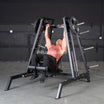
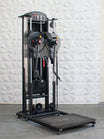

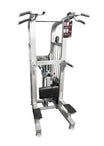
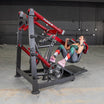
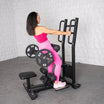
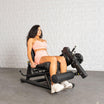
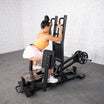
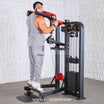

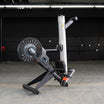
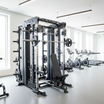
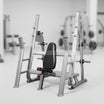

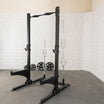
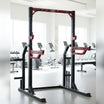
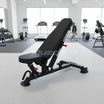


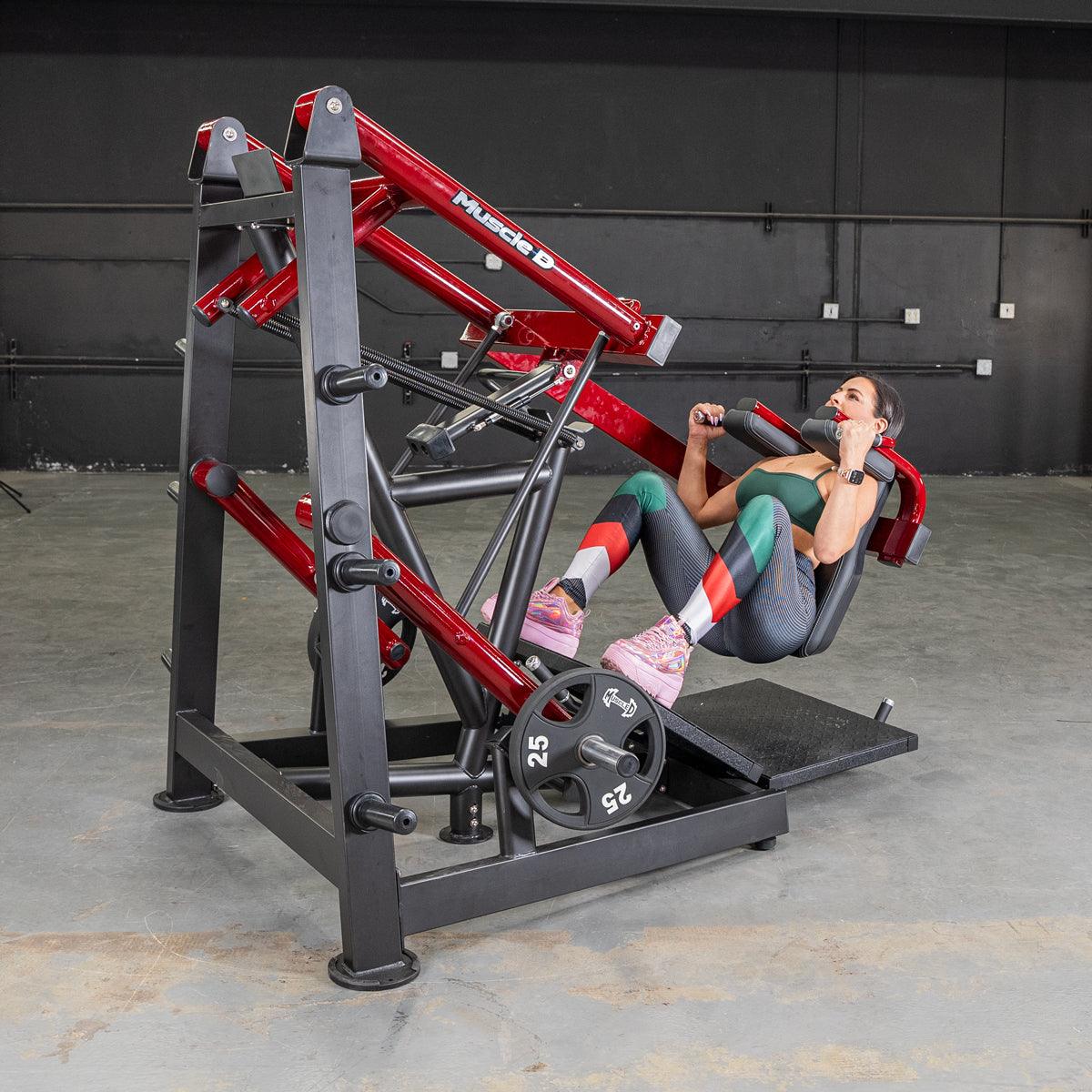
What is the best leg day machine combo? For most quad-and-glute goals, start with a pendulum squat and a hip thruster. A squat or leg press provides loaded knee and hip flexion; a thruster or glute kick adds focused hip extension. Add a leg extension and a leg curl, separately or in one combination station, for direct quadriceps and hamstring work.
This Muscle D Fitness guide is for lifters planning their training, commercial gym owners choosing equipment members will use, and home-gym buyers comparing coverage and floor space. It brings together 13 machine options, three pairing strategies, two weekly workouts and the research behind the recommendations.
Quick recommendation: Power Leverage V2 Pendulum Squat + Pro Strength Hip Thruster. For a third station, consider the Classic V2 Leg Extension / Seated Leg Curl Combo.

Why combine squat, hip-extension and isolation machines?
Quads, glutes and hamstrings do not all receive the same stimulus from one exercise. Squats and hip thrusts overlap, but they are not interchangeable. In a nine-week, volume-equated trial, Plotkin and colleagues (2023) measured similar glute growth after back-squat and hip-thrust training, but greater quadriceps and adductor growth in the squat group. Strength improvements were exercise-specific. The practical takeaway is to include both patterns when developing the thighs and glutes is the goal.
Contreras and colleagues (2015) reported higher gluteus maximus electromyographic activity during barbell hip thrusts than back squats: mean upper-glute activity of 69.5% versus 29.4%, and lower-glute activity of 86.8% versus 45.4%. Vastus lateralis activity was similar. Neto and colleagues' 2020 review also placed hip thrusts, belt squats, split squats and squats among exercises reaching very high glute activation, above 60% of maximum voluntary contraction. Activation findings describe muscle activity, not guaranteed long-term growth or the performance of every machine variation.
The pairing also offers complementary positions. Deep squatting and pressing challenge the lower body in flexed positions, while hip thrusts emphasize hip extension toward lockout. Exact resistance profiles depend on machine design, load and setup, so no single loading curve applies to every model.
Isolation work fills another gap. In Kubo, Ikebukuro and Yata's ten-week squat study (2019), knee-extensor volume increased by about 5% and gluteus maximus volume by about 7% with full squats, while rectus femoris and hamstring volume did not significantly increase in either squat-depth group. Both muscles cross the hip and knee, which helps explain why compound work does not replace targeted knee extension and flexion.
- Squat pattern: loaded knee and hip flexion for quadriceps and glutes.
- Hip thrust or kickback: focused hip extension and glute work toward lockout.
- Leg press: additional pressing volume, with single-leg options on suitable machines.
- Leg extension: direct knee-extension work, including the rectus femoris.
- Leg curl: direct knee-flexion work for the hamstrings; seated curls place the two-joint hamstrings at longer lengths than prone curls.
Rather than asking “pendulum squat or hip thrust?”, ask which squat or press fits your needs and which hip-extension station complements it. Then plan for extensions and curls.
The three best leg day machine combinations
1. The default: pendulum squat + hip thruster
Start here for a straightforward quad-and-glute pairing. The pendulum guides the squat path and removes the need to balance a barbell. Follow it with a hip thruster for focused hip extension. As a standalone pairing, try the pendulum first for 4 sets of 6–10 reps, then the thruster for 4 sets of 8–12 with a one-second pause at the top. Adjust volume to your experience and recovery.
Best for: lifters and commercial gyms prioritizing both quads and glutes. The featured pairing is the Power Leverage V2 Pendulum Squat and Pro Strength Hip Thruster.
2. The unilateral option: pendulum squat or leg press + glute kick
A single-leg kickback adds unilateral hip-extension work and helps you compare control and performance between sides. Keep a pendulum squat or leg press as the heavy lift, then use the kick as the second or third exercise for 3–4 sets of 10–15 per side. Any upper-glute or glute-medius emphasis depends on the actual movement path and setup, not the machine name alone.
Best for: physique-focused training, controlled unilateral work, and facilities adding a different glute station or reducing queues at an existing thruster. The featured pairing is the Excel Counterbalanced Pendulum Squat and Excel Linear Bearing Glute Kick. Individual joint tolerance should guide exercise choice; this is not a rehabilitation prescription.
3. The space-conscious option: leg press or Glute Line hack + thruster
A leg press and hip thruster offer pressing volume and dedicated hip extension. Foot position can change joint angles and emphasis, but it does not isolate one muscle or guarantee a particular result. Keep your pelvis supported and use a controlled range.
Alternatively, the counterbalanced Excel Glute Line Hack Squat / Front Squat combines hack, V-squat and front-squat positions in one station. The attachment recommends facing out for a quad emphasis or using a manufacturer-approved inward-facing setup for more hip emphasis. Use only positions supported by the machine's instructions.
Best for: home gyms, studios and smaller clubs comparing training coverage per station. Check operating clearance, loading access and actual dimensions before assuming either pair will fit.
| Combination | Machines | Choose it when |
|---|---|---|
| Default | Power Leverage V2 Pendulum Squat + Pro Strength Hip Thruster | You want a straightforward quad-and-glute setup. |
| Unilateral | Excel Counterbalanced Pendulum Squat + Excel Linear Bearing Glute Kick | Single-leg glute work and side-to-side control matter. |
| Pressing volume | Excel Iso-Lateral Leg Press + Pro Strength Hip Thruster | Pressing volume and independent-leg training are priorities. |
| Versatile stations | Excel Glute Line Hack Squat / Front Squat + Excel 3D Smith Machine Hip Thruster | You want several squat positions plus guided hip thrusts. |
Whichever pair you choose, add an isolation station next. Separate leg-extension and leg-curl machines, or one machine that does both, expand the program beyond quads and glutes.
Compare the Muscle D Fitness leg machines
Browse squat machines, leg press machines, glute machines, and leg extension and leg curl machines.
The specifications below are supplied in the source guide. Confirm current specifications, user limits, operating clearances and setup instructions on the linked product information before ordering or training.
Power Leverage V2 Pendulum Squat, PL-PV2-PS
This squat anchor uses 11-gauge steel, heavy-duty bearings, integrated plate storage and an adjustable footplate. Its guided pendulum arc supports loaded squatting without a barbell on your back. A slightly lower, narrower stance may increase knee demand; a higher, wider position may increase hip contribution, depending on your anatomy and depth. Use it first on a quad-priority day and set the safety stops before loading.
Explore the Power Leverage V2 Pendulum Squat.
Excel Counterbalanced Pendulum Squat, PL-E-PS2
A counterbalance offsets carriage weight, making the unloaded movement more manageable for a range of users. The source specifications list 11-gauge steel, pop-pin footplate-angle adjustment, a large textured non-slip footplate, a lever-action safety hook and stop, four 12-inch storage pegs and dual 12-inch weight horns. Dimensions: 97 in L × 59 in W × 73 in H. Consider it for stations shared by beginners, smaller lifters and advanced users, including higher-repetition training.
Explore the Excel Counterbalanced Pendulum Squat.
Excel Glute Line Hack Squat / Front Squat, PL-G-HS

This counterbalanced 3-in-1 covers hack squat, V-squat and front-squat positions. It bridges squat and glute-focused equipment by offering different body orientations within one station. The source guide describes facing out for quad emphasis and facing in with a higher foot position for more hip emphasis. Follow the approved setup and do not treat it as a replacement for direct hamstring curls.
Explore the Excel Glute Line Hack Squat / Front Squat.
Power Leverage V2 Iso Lateral 45 Degree Leg Press, PL-PV2-LPI

Eleven-gauge steel, heavy-duty bearings, integrated plate storage and an adjustable backrest support pressing volume. The defining feature is independent-leg movement. Use both legs for sets of 10–15, or add single-leg work to compare output and avoid relying on the stronger side. Adjust foot position within a range that maintains full-foot contact and pelvic support.
Explore the Power Leverage V2 Iso Lateral 45 Degree Leg Press.
Excel Iso-Lateral Leg Press, PL-E-LP

Independent arms and an adjustable seat make this an option for bilateral and single-leg volume work. Its listed dimensions are 70 in L × 62 in W × 58 in H, with a 400 lb machine weight. Consider it for home gyms or studios where the measured footprint works. It does not reproduce a pendulum's upright squat pattern, but pairs with a hip thruster or kickback for a different lower-body setup.
Explore the Excel Iso-Lateral Leg Press.
Pro Strength Hip Thruster, PL-PS-HT

The source guide lists 11-gauge steel, large commercial bearings, double-stitched upholstery, a large non-slip footplate, a sectioned back pad and four plate-storage horns. Dimensions: 73 × 60 × 47 in; machine weight: 380 lb. At setup, aim for shins close to vertical at lockout, keep the ribs controlled and chin tucked, and pause briefly at full hip extension without arching the lower back.
Explore the Pro Strength Hip Thruster.
Excel 3D Smith Machine Hip Thruster, PL-E-SMHT

Unlike a fixed vertical Smith path, the 3D carriage moves vertically and horizontally. The guide lists quick-release racking hooks, adjustable-height shoulder and back pads, a bracing handle above the hip pad, a contoured footplate and band compatibility. It has an all-black finish and 11-gauge steel construction. Dimensions: 56 in L × 60 in W × 34 in H; machine weight: 315 lb. Consider it when adjustable guided setup and band resistance are priorities; practice the racking procedure before adding load.
Explore the Excel 3D Smith Machine Hip Thruster.
Excel Linear Bearing Glute Kick, PL-E-LBG

This plate-loaded unilateral station uses commercial linear bearings, an adjustable chest pad, an oversized knee pad and a large non-slip footplate. The supplied specifications list 30 lb starting resistance and a 400 lb maximum load. Use it as a controlled finisher, train both sides and begin with the weaker side. Keep the pelvis square instead of rotating or extending the lower back to move more weight.
Explore the Excel Linear Bearing Glute Kick.
Isolation finishers: leg extensions and leg curls
Extensions and curls provide targeted work without the balance demands of a squat. Program them after compound movements, usually in the 10–20 rep range. Advanced lifters may use pre-exhaustion strategically, but it reduces the load available for later exercises. Isolation exercises still create fatigue and need controlled technique, appropriate loading, and recovery.
Seated or prone leg curl: what does the research show?
Maeo and colleagues (2021) trained one leg seated and the other prone for 12 weeks, using five sets of ten at 70% of one-repetition maximum twice weekly. Whole-hamstring volume increased 14.1% in the seated condition versus 9.3% prone. Biceps femoris long-head growth was 14.4% versus 6.5%; the single-joint short head grew similarly, approximately 10% versus 9%.
The hip-flexed seated position lengthens the two-joint hamstrings. For a first hamstring station focused on muscle size, a seated curl is a reasonable default based on this study. Prone curls remain useful for variety and training at comparatively shorter muscle lengths. These are study averages, not promised individual results or a direct test of the Muscle D machines.
Classic V2 Selectorized Leg Extension, S-CV2-LE

The dedicated extension combines 11-gauge steel, double-stitched upholstery, commercial bearings, pop-pin range-of-motion adjustment, a lever-adjusted roller pad and spring-assisted seat adjustment. The supplied specifications list a 200 lb stack, 10 lb starting resistance and integrated 2.5 lb and 5 lb micro plates. Dimensions: 50 in L × 41 in W × 64 in H; machine weight: 520 lb. The source lists no maximum user weight; confirm the applicable user limit before purchase or use.
Try 3–4 sets of 10–15 after pendulum squats, pausing briefly at extension without snapping the knee. Align the knee with the pivot before starting. A pre-exhaust placement is an optional advanced programming choice.
Explore the Classic V2 Selectorized Leg Extension.
Classic V2 Selectorized Seated Leg Curl, S-CV2-SLC

The seated curl includes a pop-pin thigh pad, lever-adjusted roller pad, spring-assisted seat, stabilizing handles and commercial bearings. The guide lists a 200 lb stack, 10 lb starting resistance, integrated 2.5 lb and 5 lb micro plates, and dimensions of 50 in L × 40 in W × 64 in H. Machine weight: 554 lb.
Program 3–4 sets of 10–15, keep the thigh restraint snug and control the return into the lengthened position. Avoid shifting the hips to finish a repetition. Pin-loaded adjustment makes load changes straightforward between users.
Explore the Classic V2 Selectorized Seated Leg Curl.
Classic V2 Selectorized Prone Leg Curl, S-CV2-PLC

The prone model offers an angled bench, quick lever-assisted pad adjustment, pop-pin range-of-motion adjustment, a resistance cam, integrated handles and commercial-grade bearings. The supplied specifications list a 200 lb stack and 2.5 lb and 5 lb micro-loading plates. Dimensions: 59 in L × 37.5 in W × 55 in H; machine weight: 482 lb.
Use it as an alternative or complement to seated curls. The weekly examples below alternate seated curls on Day A and prone curls on Day B. Keep the hips supported throughout.
Explore the Classic V2 Selectorized Prone Leg Curl.
Classic V2 Leg Extension / Seated Leg Curl Combo, S-CV2-LESLC

This is the recommended third-station option when one footprint must cover both knee extension and seated knee flexion. Features in the guide include 11-gauge steel, double-stitched upholstery, a precision cam, spring-assisted seat, lever-assisted adjustment and quick pop-pin changes. It lists a 200 lb stack, 10 lb starting resistance and integrated 2.5 lb and 5 lb micro plates. Dimensions: 60 in L × 47 in W × 64 in H; machine weight: 500 lb.
The seated curl position preserves the longer hamstring lengths discussed in the Maeo study without requiring a separate curl station.
Explore the Classic V2 Leg Extension / Seated Leg Curl Combo.
Classic V2 Leg Extension / Prone Leg Curl Combo, S-CV2-LEPLC

The prone-curl alternative combines extensions and prone curls in one selectorized footprint. The guide lists 11-gauge steel, double-stitched upholstery, quick pop-pin changeover, counterbalanced cam-driven movement, textured stabilization handles, padded elbow supports for prone curls and an adjustable seat back. Stack: 200 lb; starting resistance: 10 lb. Dimensions: 67 in L × 47 in W × 64 in H; machine weight: 505 lb.
Choose it when users prefer prone curls or you want that position in a dual-function station. Choose the seated combo when longer-length hamstring work is the priority. Separate extension and seated-curl stations allow simultaneous use when floor space and traffic justify them.
Explore the Classic V2 Leg Extension / Prone Leg Curl Combo.
Every machine at a glance
| Machine and SKU | Pattern | Training role |
|---|---|---|
| Power Leverage V2 Pendulum Squat, PL-PV2-PS | Squat | Quads and glutes in a guided squat. |
| Excel Counterbalanced Pendulum Squat, PL-E-PS2 | Squat | Counterbalanced squat for varied users. |
| Excel Glute Line Hack / Front Squat, PL-G-HS | Squat | Several squat positions in one station. |
| Power Leverage V2 Iso Lateral Leg Press, PL-PV2-LPI | Leg press | Quad and glute volume; independent-leg option. |
| Excel Iso-Lateral Leg Press, PL-E-LP | Leg press | Seated pressing and single-leg work. |
| Pro Strength Hip Thruster, PL-PS-HT | Hip thrust | Dedicated glute-focused hip extension. |
| Excel 3D Smith Hip Thruster, PL-E-SMHT | Hip thrust | Guided hip extension and band compatibility. |
| Excel Linear Bearing Glute Kick, PL-E-LBG | Kickback | Unilateral hip extension. |
| Classic V2 Leg Extension, S-CV2-LE | Knee extension | Direct quadriceps work; 200 lb stack. |
| Classic V2 Seated Leg Curl, S-CV2-SLC | Seated knee flexion | Hamstrings at longer muscle lengths. |
| Classic V2 Prone Leg Curl, S-CV2-PLC | Prone knee flexion | Hamstrings at comparatively shorter lengths. |
| Classic V2 Extension / Seated Curl, S-CV2-LESLC | Extension + seated curl | Quads and hamstrings in one station. |
| Classic V2 Extension / Prone Curl, S-CV2-LEPLC | Extension + prone curl | Quads and hamstrings in one station. |
Two leg-day workouts using the machine combo
Use these as adjustable training examples, not a requirement to complete every exercise. They are demanding sessions for experienced lifters. Beginners can start with the squat or press, a thruster and one extension/curl station at lower set counts. Warm up, use the safety features and leave recovery time between leg sessions.
The source programming framework emphasizes mostly 6–15 repetitions, with some isolation work up to 20, and hard sets finishing about 0–3 repetitions in reserve. RIR means the number of additional clean repetitions you estimate you could complete. Schoenfeld, Ogborn and Krieger's 2017 meta-analysis found a volume-related hypertrophy trend, including greater average gains in groups performing ten or more weekly sets per muscle than lower-volume groups. More work is not automatically better for every lifter.
The full examples contain substantial overlapping quad and glute work. They also provide six direct extension sets and five to six direct curl sets weekly when each day is performed once. Count overlapping work conservatively rather than assuming every compound set is a full set for every muscle. Start below the full prescription if needed and increase volume only when recovery and performance support it.
Leg Day A: quad emphasis, pendulum first
| Order and exercise | Sets × reps | Effort | Rest |
|---|---|---|---|
| 1. Pendulum squat, comfortable lower-foot setup and controlled depth | 4 × 6–10 | 1–2 RIR | 2–3 min |
| 2. Leg press or outward-facing Glute Line hack | 3 × 10–15 | 1 RIR | 90 sec–2 min |
| 3. Hip thruster, one-second top pause | 3 × 10–12 | 0–1 RIR | 90 sec |
| 4. Optional glute kick | 2 × 12–15 per side | 0–1 RIR | 60 sec |
| 5. Leg extension, brief controlled pause at extension | 3 × 12–15 | 0–1 RIR | 60–90 sec |
| 6. Seated leg curl | 3 × 10–15 | 0–1 RIR | 60–90 sec |
Leg Day B: glute emphasis, thrust first
| Order and exercise | Sets × reps | Effort | Rest |
|---|---|---|---|
| 1. Hip thruster, heaviest sets first with one-second top pause | 4 × 6–10 | 1–2 RIR | 2 min |
| 2. Pendulum squat with comfortable higher/wider stance, or approved inward-facing Glute Line setup | 3 × 8–12 | 1–2 RIR | 2 min |
| 3. Single-leg leg press | 3 × 10–12 per side | 1 RIR | 90 sec |
| 4. Glute kick | 3 × 10–15 per side | 0–1 RIR | 60 sec |
| 5. Leg extension | 3 × 12–20 | 0–1 RIR | 60 sec |
| 6. Prone leg curl or combo-station prone curl | 2–3 × 10–15 | 0–1 RIR | 60 sec |
Zero RIR is an option for experienced lifters on suitable exercises, not a requirement. Stop when clean technique breaks down and use the manufacturer's safety procedures.
How to progress the workouts
- Use double progression: keep the same load until every set reaches the top of its rep range with controlled form, then use the smallest practical increase.
- Prioritize progress on the first lift. Let accessories follow rather than adding kickback weight through hip rotation or lower-back arching.
- Consider a lighter week around every fourth week, or sooner when recovery and performance call for it. The source example reduces sets by about one-third while keeping loads similar, but pain may require more adjustment.
- Log load, reps and RIR so progression is measurable.
Technique rules that make the combo work
- Treat foot placement as a dial: lower or higher positions can change knee and hip demands, but individual anatomy and machine design matter. Keep the whole foot planted and knees tracking comfortably with the toes.
- Earn your depth: lower under control, roughly two to three seconds, and use the deepest range you can maintain with a stable pelvis and full-foot contact. Do not bounce through the bottom.
- Finish the hip thrust without back extension: keep the ribs controlled, chin tucked and pelvis stable. Pause at hip lockout. If your back dominates the movement, reduce the load and reassess setup rather than forcing the rep.
- Keep kickbacks square: brace, keep the pelvis level and move at the hip. Avoid swinging or rotating open.
- Use safety stops and racks: practice them before a hard set. Guided machines do not eliminate risk. Keep at least one clean repetition in reserve on the first exercise if you are unsure of your limits.
- Set the extension pivot: align the knee with the machine pivot and place the roller just above the ankle. Use a pain-free range and avoid snapping into extension.
- Control the curl: keep the hips supported and pelvis still. On seated curls, secure the thigh pad and control the return into the lengthened position; stop if the hips lift or the lower back arches.
How to choose your leg machines in 60 seconds
- Start with a pendulum squat when quads are a priority and the movement suits your joints and available space. Pair it with a thruster for glutes.
- Choose a leg press when supported pressing, volume or independent-leg work better fits your users. Do not assume a press is automatically appropriate for knee pain or every beginner.
- Add a hip thruster for dedicated glute-focused hip extension. Compare the 3D Smith model when guided setup and band loading matter.
- Add a glute kick for unilateral work and side-to-side control, often as a second glute option rather than your only lower-body station.
- Complete the setup with a Classic V2 leg extension and seated curl, or the extension / seated curl combo when one footprint must do both.
- If buying only two stations, compare the Glute Line Hack / Front Squat and a thruster against the actual room dimensions. Add extension/curl capability when space and budget allow.
Frequently asked questions
Can a leg press replace a pendulum squat?
It can replace the pressing role in a program, but not the exact movement. Both train quads and glutes; a leg press uses a seated or reclined setup rather than a pendulum's guided squat pattern. If you already own a suitable press, adding a hip thruster expands your movement options. If you own neither, compare both against user preference, joint tolerance and space.
Is a hip thrust or a glute kick better for glutes?
A hip thruster is the default recommendation here for bilateral loading and dedicated hip extension. A glute kick provides unilateral work and may suit users who prefer that setup. Heavier loading alone does not prove superior growth; choose the movement you can perform and progress well. A fuller facility may benefit from both.
How many leg machines does a small gym need?
Two complementary stations cover a useful starting point: a squat or press and a hip-extension machine. A third station that combines leg extensions and curls adds direct knee-extension and hamstring work. Add further kickback or pressing stations when demand and queues justify the floor space.
Do I still need leg extensions if I squat and leg press?
Leg extensions are useful when direct quadriceps work, especially rectus femoris development, is a priority. Kubo and colleagues found no significant rectus femoris growth after their squat intervention despite growth in other knee extensors. That supports including targeted extension work, rather than claiming squats never train the muscle or that extensions are the only possible way to train it.
Should I buy a seated or prone leg curl first?
For a hypertrophy-focused first purchase, the seated curl is a reasonable choice based on Maeo and colleagues' study: about 14% whole-hamstring growth seated versus 9% prone over 12 weeks. The Classic V2 Seated Leg Curl (S-CV2-SLC) or Extension / Seated Curl Combo (S-CV2-LESLC) keeps that position. Choose the Prone Leg Curl (S-CV2-PLC) or Extension / Prone Curl Combo (S-CV2-LEPLC) when users prefer prone training or you want a complementary position.
What if my knees hurt during pendulum squats?
Do not push through pain. Reduce the load and use a pain-free range, checking setup and foot position. A different exercise may be more comfortable, but no machine is a universal solution. Persistent or worsening pain deserves assessment by a qualified clinician.
Research and programming references
The studies below informed the source guide. Most investigated free-weight exercises or specific research protocols, not these exact machines; their findings provide context rather than product-specific outcome guarantees.
- Contreras B, Vigotsky AD, Schoenfeld BJ, Beardsley C, Cronin J. A comparison of gluteus maximus, biceps femoris, and vastus lateralis electromyographic activity in the back squat and barbell hip thrust exercises. Journal of Applied Biomechanics. 2015;31(6):452–458. Read the study.
- Plotkin DL et al. Hip thrust and back squat training elicit similar gluteus muscle hypertrophy and transfer similarly to the deadlift. 2023. Read the research record.
- Neto WK et al. Gluteus maximus activation during common strength and hypertrophy exercises: a systematic review. Journal of Sports Science & Medicine. 2020;19(1):195–203. Read the review.
- Schoenfeld BJ, Ogborn D, Krieger JW. Dose-response relationship between weekly resistance training volume and increases in muscle mass: a systematic review and meta-analysis. Journal of Sports Sciences. 2017;35(11):1073–1082. Read the review record.
- Kubo K, Ikebukuro T, Yata H. Effects of squat training with different depths on lower limb muscle volumes. European Journal of Applied Physiology. 2019;119(9):1933–1942. Read the study.
- Maeo S, Huang M, Wu Y, Sakurai H, Kusagawa Y, Sugiyama T, Kanehisa H, Isaka T. Greater hamstrings muscle hypertrophy but similar damage protection after training at long versus short muscle lengths. Medicine & Science in Sports & Exercise. 2021;53(4):825–837. Read the study.
Additional professional programming frameworks named in the source: the American College of Sports Medicine's Guidelines for Exercise Testing and Prescription and resistance-training position stand; the National Strength and Conditioning Association's Essentials of Strength Training and Conditioning; and Bret Contreras' Glute Lab (Victory Belt, 2019), for hip-thrust setup and glute-programming practice.
Build your leg-training setup
Start with complementary movement patterns, then choose the models that fit your members, room and training goals. Explore Muscle D squat machines, leg presses, glute machines, and leg extension and curl machines.
For equipment-selection help, contact Muscle D Fitness at (888) 532-1413 or info@muscledfitness.com.

Dejar un comentario
Todos los comentarios se revisan antes de su publicación.
Este sitio está protegido por hCaptcha y se aplican la Política de privacidad de hCaptcha y los Términos del servicio.