




























What is Training Load? (The Ultimate Progress Metric)
In the legendary tales of ancient Greece, Milo of Croton became the strongest man alive by carrying a newborn calf on his shoulders every single day. As the calf grew into a massive bull, Milo's body adapted to the changing stimulus, developing unprecedented strength. This is the oldest recorded example of progressive overload—the foundational law of physical transformation.
Most modern lifters interpret Milo's story too literally. They think progressive overload means only one thing: add weight to the bar every single week.
But what happens when you hit a wall? What happens when adding five pounds means your form breaks down, your joints ache, and your progress stalls?
If adding weight is your only tool, you will quickly run out of runway. True progressive overload is multifaceted. To master your fitness journey, you need to understand your primary metric of progress: Training Load, and how to manipulate its variables to force continuous physical adaptation in both strength and cardio training.
What is Training Load?

To track your progress scientifically, you cannot rely on "feeling the burn." You need concrete numbers. In strength training, this is called your Volume Load or Training Load, and it is calculated using a simple formula:
Training Load = Sets × Reps × Weight
This equation gives you a precise, mathematical way to measure the total mechanical work your muscles perform during an exercise or an entire workout.
Example: The Anatomy of a Single Exercise
If you perform 3 sets of 10 reps with 25 lbs on a bicep curl, your training load for that exercise is:
3 × 10 × 25 lbs = 750 lbs of total work
Example: Tracking an Entire Workout
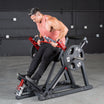
To track an entire workout, add up the training load of each individual exercise. Here's a structured "Back Day" using four primary movements: Bent-over Rows, Seated Rows, Lat Pulldowns, and High Rows.
Performing 3 sets of 10 reps at 100 lbs for each of these four exercises:
- Load per set: 1 × 10 × 100 lbs = 1,000 lbs
- Load per exercise: 3 × 10 × 100 lbs = 3,000 lbs
- Total Training Load for the workout: 3,000 lbs × 4 exercises = 12,000 lbs
By establishing this baseline of 12,000 lbs, you have an absolute metric to beat in your next session.
The 4 Vectors of Progress: How to Increase Training Load
The Training Load formula proves that weight is only one-third of the equation. If your goal is to force your body to adapt, grow, and get stronger, there are four distinct variables you can manipulate in a strength or cardio session:
1. Increase Weight (Intensity Progression)
This is the classic Milo method. By keeping your sets and reps the same but increasing the weight, you increase absolute mechanical tension.
- Strength Application: Moving from 100 lbs to 105 lbs on your rows.
- Cardio Application: Increasing the resistance level on an elliptical or the incline on a treadmill.
2. Increase Reps (Repetition Progression)
Keeping the weight and sets identical but pushing for more repetitions increases your muscles' time under tension and metabolic stress.
- Strength Application: Pushing your sets from 10 reps to 12 reps with the same 100 lbs.
- Cardio Application: Increasing your stride rate (cadence/RPM) over a fixed time block.
3. Increase Sets (Volume Progression)
Adding an extra set multiplies your total work capacity. It is one of the most powerful triggers for muscle hypertrophy.
- Strength Application: Moving from 3 sets of 10 to 4 sets of 10.
- Cardio Application: Adding an extra round of a high-intensity interval (e.g., performing 5 sprint intervals instead of 4).
4. Increase the Number of Exercises (Density/Diversity Progression)
Introducing a new movement adds an entirely new block of training load to your workout while targeting the musculature from a fresh angle.
- Strength Application: Adding 3 sets of 10 reps of Reverse Flys to your back day.
- Cardio Application: Adding a 10-minute rowing machine block to the end of a running session.
By cycling through these four methods, you ensure steady, injury-free progress without ever getting stuck in a weight-induced plateau.
The Science: Why Volume and Load Manipulation Work
This isn't just bro-science — it is heavily backed by exercise physiology.
A seminal meta-analysis published by Dr. Brad Schoenfeld (2017) demonstrated a clear dose-response relationship between training volume and muscle growth (hypertrophy). The research established that higher training volumes — specifically tracking toward 10 to 20 sets per muscle group per week — elicit significantly greater muscle mass gains than low-volume routines.
Furthermore, a 2022 study published in PeerJ explicitly compared load progression (adding weight) against repetition progression (adding reps). The researchers discovered that both methods yielded identical increases in muscle thickness. The scientific consensus is clear: your muscles do not have eyes. They do not know how much the iron plate weighs; they only sense mechanical tension, metabolic stress, and the total accumulation of absolute Training Load. Pushing closer to muscular failure by adding reps or sets is just as effective for muscle growth as adding external weight.
Macro-Periodization: A Practical 6-Week Macro Cycle

Here's how this works over time — a professional, periodized 6-week training block built on our 12,000 lb back workout baseline. Instead of adding weight every week, we systematically manipulate sets, reps, and exercise selection.
Phase 1: The Volume Accumulation Block
During these weeks, we keep the weight steady at 100 lbs and use reps and sets to skyrocket our total training load.
- Weeks 1 & 2 (The Baseline): 4 exercises (Bent-over Rows, Seated Rows, Lat Pulldowns, High Rows) — 3 sets × 10 reps @ 100 lbs — Total: 12,000 lbs
- Week 3 (The Rep Jump): 4 exercises — 3 sets × 12 reps @ 100 lbs — Total: 14,400 lbs (A 20% increase in work!)
- Week 4 (The Endurance Peak): 4 exercises — 3 sets × 15 reps @ 100 lbs — Total: 18,000 lbs
- Week 5 (The Volume Surge): 4 exercises — 4 sets × 15 reps @ 100 lbs — Total: 24,000 lbs (Double your original baseline workload!)
- Week 6 (The Absolute Peak): 4 exercises — 5 sets × 15 reps @ 100 lbs — Total: 30,000 lbs
Resetting and Evolving: The Next Cycle

At the end of Week 6, your body will have accumulated significant systemic fatigue. To capitalize on this, you execute a strategy called functional overreaching.
On Week 7, you drop back down to your baseline structure: 3 sets of 10 reps.
Because your body adapted to handle 30,000 lbs of work in Week 6, 12,000 lbs will feel incredibly light. Your central nervous system has upgraded, your muscle fibers have grown, and your absolute strength has increased.
Now, you can safely add weight. You jump from 100 lbs to 110 lbs per exercise.
Your new baseline is: 3 sets × 10 reps × 110 lbs × 4 exercises = 13,200 lbs
To push adaptation even further, you introduce a 5th exercise to target a new vector: Reverse Flyes (for the rear deltoids and upper back). Here's how the next block builds upon your new strength foundation:
-
Weeks 7 & 8 (New Weighted Baseline + Exercise Addition):
- Week 7: 4 primary exercises — 3 sets × 10 reps @ 110–120 lbs (13,200–14,400 lbs)
- Week 8: 4 primary exercises — 3 sets × 10 reps @ 120–130 lbs (14,400–15,600 lbs)
- Added exercise — Reverse Flys: 3 sets × 10 reps @ 20 lbs (600 lbs)
- Total Workout Training Load: 13,800–16,200 lbs
- Week 9 (Rep Progression): 3 sets × 12 reps (scale weight/exercises accordingly)
- Week 10 (Endurance Progression): 3 sets × 15 reps
- Week 11 (Set Expansion): 4 sets × 15 reps
- Week 12 (Peak Volume): 5 sets × 15 reps
The Milo Summary: Track Intelligently
If you only try to progress by lifting heavier, you will eventually face plateaus, joint wear, and mental burnout. By understanding that Training Load = Sets × Reps × Weight, you open up an entire toolbox of progression.
When the weight feels too heavy, add a rep. When you can't add a rep, add a set. When your workout feels complete, introduce a new movement pattern. Track your total training load, let it climb systematically over a 6-week block, reset, increase your baseline weight, and watch your body transform — just like Milo of Croton.
References
- Schoenfeld, B. J., Ogborn, D., & Krieger, J. W. (2017). Dose-response relationship between weekly resistance training volume and increases in muscle mass: A systematic review and meta-analysis. Journal of Sports Sciences, 35(11), 1073–1082.
- Plotkin, D., et al. (2022). Progressive overload by altering resistance load or repetitions: Effects on training adaptations in resistance-trained individuals. PeerJ, 10, e14140.



Dejar un comentario
Todos los comentarios se revisan antes de su publicación.
Este sitio está protegido por hCaptcha y se aplican la Política de privacidad de hCaptcha y los Términos del servicio.