





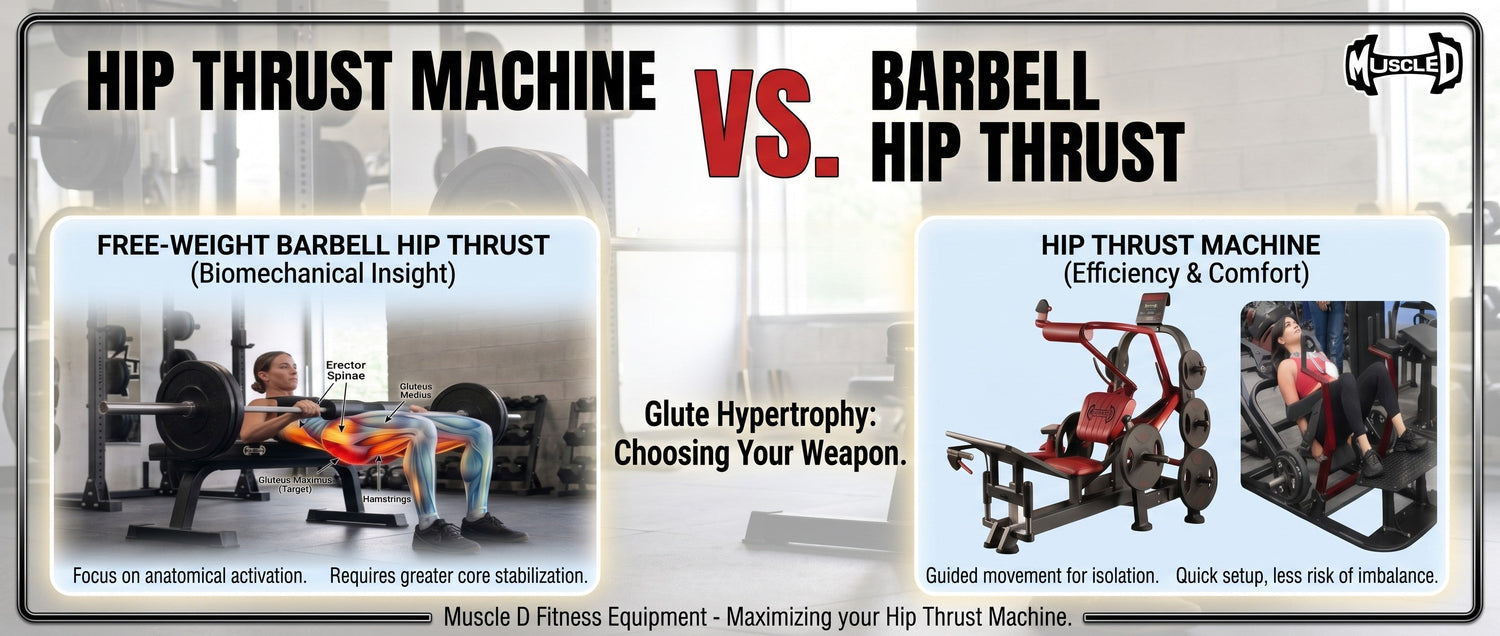
Hip Thrust Machine vs. Barbell Hip Thrust: Biomechanics, Efficiency & Glute Hypertrophy
When it comes to targeted lower-body development, few exercises match the effectiveness of horizontal hip extension. Popularized in biomechanical research by Contreras et al. (2011), the hip thrust places maximum tension on the gluteus maximus at full hip extension, a position where squats and deadlifts lose mechanical advantage.
As glute training has grown in popularity, gym owners and facility operators face a practical question: Should you stick with the traditional barbell hip thrust, or invest in a dedicated plate-loaded or selectorized hip thrust machine? This guide breaks down the science, the tradeoffs, and the best commercial solutions.
1. Biomechanics & Research: Which Variation Wins?
To determine which variation produces superior glute hypertrophy and power output, we need to examine muscle activation, force vectors, and joint kinetics.
Surface Electromyography (sEMG) Findings
Research consistently shows that horizontal hip thrusts elicit significantly higher upper and lower gluteus maximus sEMG activity compared to vertical movements like the back squat (Contreras et al., 2015). When comparing a barbell hip thrust to a machine glute drive, two key differences emerge:
- Peak Contraction: Both exercises deliver peak mechanical tension at neutral or slight hip hyperextension (0° hip angle).
- Torque Curve: Free-weight barbells rely on gravity (F = mg), so effective resistance torque decreases as the bar moves horizontally toward the hip joint. Dedicated machines use custom dynamic cams or pivot points to maintain constant tension throughout the full range of motion — eliminating the "dead spot" at the bottom of the movement.
Stabilization & Target Muscle Isolation
Free-weight compound lifts require significant co-contraction of stabilizer muscles — including the erector spinae, core, and ankle stabilizers.
- Barbell Hip Thrusts demand active stabilization to prevent the bench from shifting and the bar from rolling.
- Machine Glute Drives fix the upper back against a specialized pivot pad and anchor the feet to a non-slip platform. Removing the balance requirement allows lifters to push closer to absolute mechanical failure without technique breakdown.
2. Benefits of the Barbell Hip Thrust
Despite the rise of dedicated machines, the barbell hip thrust remains a staple in strength and conditioning programs.
- Universal Accessibility: Every commercial facility, athletic weight room, and home gym has a bench, barbell, and plates.
- Core & Stabilizer Recruitment: Managing a heavy, unguided load forces the deep core, lower back, and adductors to work continuously.
- Athletic Transfer: Multi-planar balance demands translate well to field sports, sprinting, and vertical jumping.
3. Benefits of Machine Glute Drives & Hip Thrusters
Dedicated hip thrust machines solve nearly every logistical and mechanical drawback of the free-weight movement.
- Faster Setup: No rolling barbells, hunting for hip pads, or anchoring a bench. A dedicated machine is ready in seconds — adjust the pad, load the weight, and go.
- Superior Comfort at High Loads: Heavy barbell hip thrusts are notorious for painful pelvic pressure. Machine designs use wide padded waist belts or integrated lap bars that distribute force evenly, enabling higher volume without bruising.
- Built-In Safety: Mechanical safety catches eliminate the risk of dropping weights, slipping off a bench, or hyperextending the lumbar spine — allowing lifters to safely train to complete failure.
- Lower Learning Curve: Beginners often struggle with the awkward barbell setup. Machines provide a guided path of motion, reducing onboarding time for personal training clients and general members.
4. Head-to-Head Comparison
| Feature | Barbell Hip Thrust | Machine Glute Drive / Hip Thruster |
|---|---|---|
| Setup Time | High (3–5 minutes) | Low (10–30 seconds) |
| Pelvic Comfort | Low to Moderate (requires foam pad) | High (padded belts or integrated lap pads) |
| Stabilizer Recruitment | High (active core & spinal control required) | Moderate (guided movement concentrates load on glutes) |
| Max Load Potential | High | Extremely High (safe failure with mechanical catches) |
| Floor Space | Flexible (standard gym floor) | Dedicated footprint |
5. Commercial Hip Thrust Machines by Muscle D Fitness
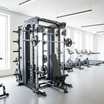
Looking to upgrade your facility's lower-body training area? Muscle D Fitness offers commercial-grade hip thrust solutions built for fitness centers, personal training studios, and athletic clubs.
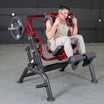
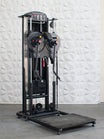
Excel Leverage Hip Thruster

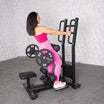
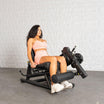
Plate-loaded with a natural biomechanical arc that matches the body's strength curve. Minimal setup friction, maximum glute isolation. View the Excel Leverage Hip Thruster →
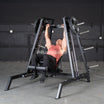
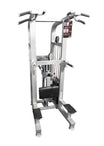
Excel 3D Smith Machine Hip Thruster

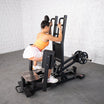
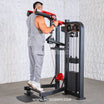
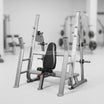
Combines multi-plane freedom with guided safety. Allows natural horizontal and vertical travel while maintaining a secure, fixed environment for heavy overload. View the Excel 3D Smith Machine Hip Thruster →
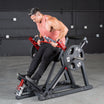
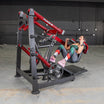
Pro Strength Hip Thruster

Engineered for high-traffic commercial environments. Features heavy-duty steel frame construction, dense commercial padding, and intuitive user entry/exit design. View the Pro Strength Hip Thruster →
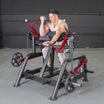
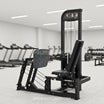
Plate Loaded Glute Bridge Hip Thruster Machine

Targets the gluteus maximus with a precise biomechanical pivot point. Maximum pelvic comfort and integrated safety catches for training to failure. View the Plate Loaded Glute Bridge Hip Thruster →
The Verdict
Both variations have earned a place in modern strength programs. The barbell hip thrust is ideal for minimalist setups and athletic development requiring multi-planar balance. But for targeted hypertrophic efficiency, commercial throughput, user comfort, and training intensity, machine glute drives are the clear choice for the modern commercial gym.
References
- Contreras, B., Vigotsky, A. D., Schoenfeld, B. J., Beardsley, C., & Cronin, J. (2015). A comparison of gluteus maximus, biceps femoris, and vastus lateralis electromyographic activity in the back squat and barbell hip thrust exercises. Journal of Applied Biomechanics, 31(6), 452–458.
- Contreras, B., Cronin, J., & Schoenfeld, B. J. (2011). Barbell hip thrust. Strength & Conditioning Journal, 33(5), 102–108.

Dejar un comentario
Todos los comentarios se revisan antes de su publicación.
Este sitio está protegido por hCaptcha y se aplican la Política de privacidad de hCaptcha y los Términos del servicio.