






Meet Brian Lewallen: the OG behind multi-gym design
Meet Brian Lewallen. If you’ve ever stepped foot into a commercial health club, a hotel fitness center, or an apartment training studio, you’ve likely benefited from his work.
As an industry original and a founding force behind Muscle Dynamics (now Muscle D Fitness), Brian has spent more than five decades solving one problem: how do you pack maximum muscle-building utility into minimal square footage, without sacrificing biomechanics, safety, or flow?
We sat down with Brian to talk about the history, engineering, and future of multi-station gym design, and why multi-gyms continue to dominate modern facility layouts.
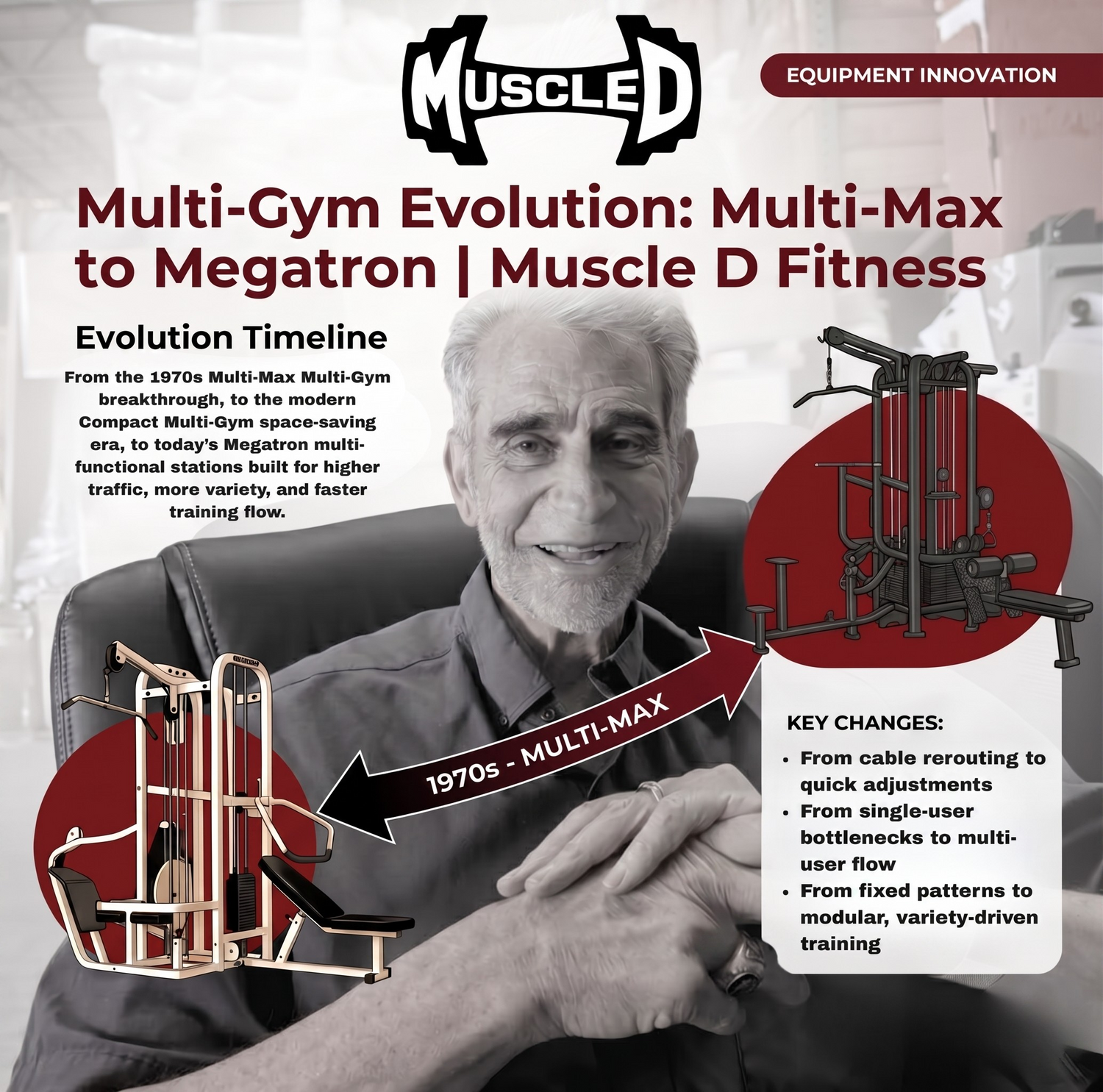
The 1970s breakthrough: the original Multi-Max Multi-Gym

In the mid-1970s, the fitness landscape was changing fast. Early multi-station systems existed, but they were rigid and frustrating to use. Changing exercises often meant unhooking and rerouting heavy cables, hardly a smooth experience for members or staff.
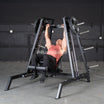
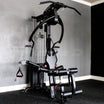
Brian and his team set out to change that with the original Muscle Dynamics Multi-Max Multi-Gym. The goal was simple: deliver an all-around, anatomically correct workout for all major muscle groups on a single independent footprint.
As Brian put it:
“The demand back then was for a lot of exercises in a small amount of space, particularly for homes, hotels, and smaller facilities. We wanted to get the most bang for the buck. The trick was making sure each station could be used independently with minor adjustments, like our multi-press system that went from bench press to incline to shoulder press seamlessly.”
To keep multiple users moving without gym-floor gridlock, the 4-stack configuration became the benchmark. Placed centrally in a room for 360-degree traffic flow, it changed how club owners planned their floor layouts, and it’s still a core concept today.
The modern era: Muscle D Fitness and the space-saving revolution

Fast forward to the late 2010s. Muscle Dynamics evolved into Muscle D Fitness, bringing decades of real-world biomechanics into the modern era.
The result: a new generation of multi-gyms built for today’s facilities, where square footage is expensive, member expectations are higher, and training styles are more varied than ever.
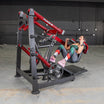
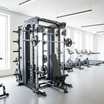
The Compact Multi-Gym , in particular, was designed as a major upgrade from the old-school chrome machines of the past, with a heavier focus on precision anatomical correctness, smarter pulley placement, and better muscle isolation.
Why multi-station gyms save space (and reduce congestion)
No matter the facility type, boutique studio, corporate wellness room, apartment gym, or full-scale commercial club, owners face the same reality: they need more training options in less space.
Multi-station systems win because they solve three problems at once:
· Massive space efficiency: A well-designed multi-station system can save 60% to 80% of floor space compared to buying standalone single-station units.
· Reduced congestion: Doubling up on high-demand movements and using central bridging pieces (like a pull-up bar connecting two towers into an 8-stack) helps facilities handle more users without bottlenecks.
· Unmatched exercise variety: Multi-stations naturally support variable resistance cams and diverse pulley placements that better match how different muscle groups function.
Standard vs. Deluxe Jungle Gym: what’s the difference?
As the lineup expanded, user behavior started shaping the engineering.
Muscle D Fitness developed two distinct tracks for multi-station layouts.
Standard Jungle Gym

This configuration keeps a highly popular, classic layout:
· A completely separate lat pull-down station
· A completely separate low row station
· Two functional cable columns, one engineered with a single-handle setup and the other with a double-handle setup
It’s a proven, familiar layout that works across a wide range of facilities.
Deluxe Jungle Gym

The Deluxe line took customization further by incorporating independent handles on both the pressing and lat pull-down stations.
Brian says the innovation came directly from watching people improvise on the gym floor:
“We watched how people used the machines, and we learned from them. Users would grab a traditional lat bar with one hand to try and do single-arm crossover work. We realized they wanted to isolate single muscle groups and attack them from multiple angles. We didn’t invent that desire; we just built the capability directly into the machine’s pulleys and handles.”
Multi-gym lineup: choose the right footprint for your facility
From tight footprints to high-traffic training floors, today’s multi-station options cover almost every facility need.
|
Equipment style |
Standalone machines replaced |
Best suited for |
Standout features |
|
Compact Single Stack |
12–15 machines |
Tight boutique spaces, hotels, home gyms |
Single weight stack, highly adjustable multi-angle cables |
|
Compact Multi-Gym |
8-15 machines |
Multi-family housing, corporate wellness |
Small footprint, multi-press chest/incline/shoulder arms |
|
Standard Jungle Gym (4-Stack) |
6-8 machines |
Mid-sized studios, wellness centers |
Separate lat/low row stations, dual functional columns |
|
Deluxe Jungle Gym (8-Stack) |
6-10 machines |
High-traffic commercial clubs |
Independent moving handles, Heavy duty design for high traffic facilities. |
Megatron multi-functional stations: the next generation of training

Innovation hasn’t slowed down.
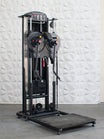
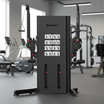
By distilling decades of multi-stack logic into a more performance-driven format, Muscle D Fitness developed the latest functional training powerhouses: the Megatron 2-stack and 3-stack multi-functional training stations.
These heavy-duty systems bridge the gap between commercial circuit training and high-performance athletic conditioning.
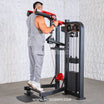
The newest functional-style 4-station units go even further, allowing gym owners to mix and match modular components, including specialized stations like:
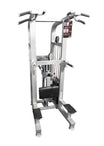
· Assisted chin/dip
· Pec fly / rear delt combo
· Other modular station options built directly into the stack hub
Ultimately, keeping weight training dynamic is what keeps people coming back.
“Weight training can get pretty boring if you’re forced to do the exact same linear movement for three sets over and over,” Brian says. “People want variety, and they want to move efficiently through their routines. By building that versatility into the core architecture of the machines, we let the audience drive the workout.”
Explore Muscle D Fitness multi-gym options
If you’re planning a facility buildout (or upgrading an existing floor), here’s the current multi-gym and multi-function lineup:
· 4-Stack Megatron Deluxe Jungle Gym: https://muscledfit.com/products/copy-of-4-stack-megatron-deluxe-jungle-gym-3-colors
· 4-Stack Megatron Jungle Gym: https://muscledfit.com/products/4-stack-megatron-jungle-gym-2-versions
· 4-Stack Megatron Compact Multi-Gym: https://muscledfit.com/products/4-stack-megatron-compact-multi-gym
· 4-Stack Jungle Gym w/ Assisted Chin/Dip Station: https://muscledfit.com/products/megatron-4-stack-jungle-gym-assisted-chin-dip-low-row-lat-pulldown-functional-column
· 4-Stack Jungle Gym w/ Pec / Rear Delt Station: https://muscledfit.com/products/megatron-4-stack-jungle-gym-pec-rear-delt-low-row-lat-pulldown-functional-column
· Megatron Multi-Functional Training Station (2-Stack / 3-Stack): https://muscledfit.com/products/megatron-multi-functional-training-station-2-stack-3-stack
· Compact Single Stack Multi-Gym: https://muscledfit.com/products/compact-single-stack-multi-gym-muscle-d-fitness
If you want help choosing the right configuration, the best place to start is your footprint, traffic level, and the top 5 movements your members train every week.
Contact us anytime with questions or to decide on the Multi-Gym that fits your needs!

Dejar un comentario
Todos los comentarios se revisan antes de su publicación.
Este sitio está protegido por hCaptcha y se aplican la Política de privacidad de hCaptcha y los Términos del servicio.