










































Getting MuscleD w/ Muscle D: Milo’s Progressive Overload Density Playbook
 Milo: The Original Progressive Overload Story
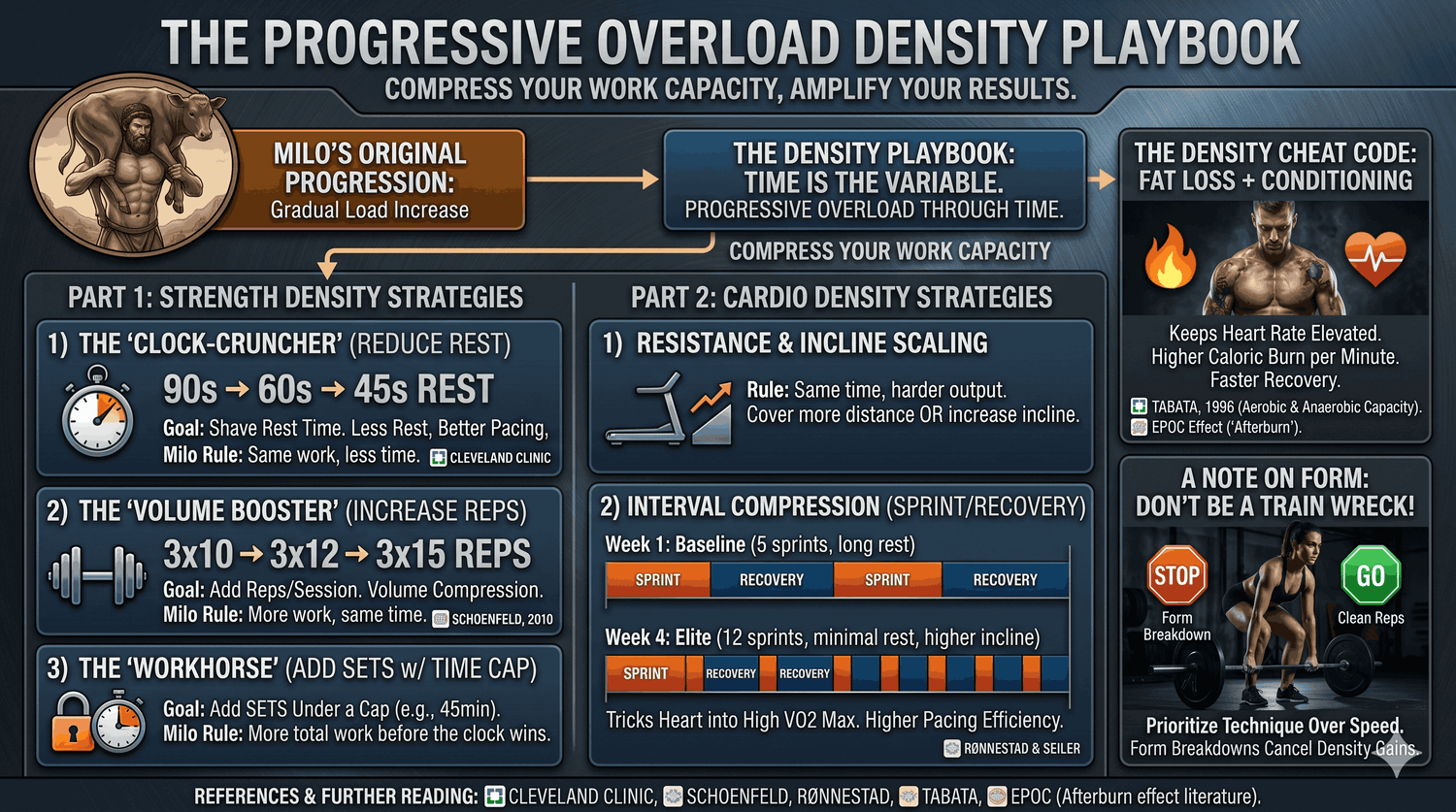
Before we talk density, we need to talk Milo of Croton, the legend often credited as the first “progressive overload” athlete.
The story goes like this: Milo carried a young calf every day. As the calf grew, the load increased. Milo got stronger because the challenge increased gradually, consistently, and predictably.
That’s why Milo matters in modern training. He reminds us that progress isn’t random; it’s built by adding stress in a way your body can adapt to.
The “Forgotten” Variable: Progressive Overload Through Time
Most lifters only think of overload as “add weight to the bar.” That works—but it’s not the whole playbook.
Training density is progressive overload through time:
- More work in the same time, or
- The same work in less time
In other words, you’re not just getting stronger, you’re getting more efficient. You’re compressing your work capacity. In fact, clinical experts at the Cleveland Clinic explicitly define systematically shortening your rest periods as a core pillar of progressive overload, because forcing your muscles to adapt to higher metabolic fatigue triggers massive gains in endurance and efficiency.
Milo’s Progressive Overload Density Playbook
Think of this as Milo’s modern twist: instead of only carrying a heavier calf, you’re carrying the same calf faster, with less downtime, or with more total work before the clock runs out.
Part 1: Strength Density Strategies
Increasing density in lifting is about compressing your work capacity while keeping technique clean.
1) The “Clock-Cruncher” (Reducing rest)
- Goal: Keep sets, reps, and load identical, just shave recovery time.
- Example progression: 90s ---> 60s ---> 45s rest
- Why it works: Less rest forces better pacing, better breathing control, and higher output per minute.
-
Milo rule: Same work, less time.

2) The “Volume Booster” (Increasing reps)
- Goal: Keep rest periods and total session time the same, but add reps per set.
- Example progression: 3x10 ---> 3x12 ---> 3x15
- Why it works: You’re completing more total work without extending the session. Landmark research by hypertrophy expert Dr. Brad Schoenfeld (2010) shows that this kind of volume compression creates immense metabolic stress—the buildup of metabolites like lactate—which is a primary driver of muscle growth, even without adding heavier weights.
- Milo rule: More work, same time.
3) The “Workhorse” (Increasing sets under a time cap)
- Goal: Add sets while strictly adhering to a hard time cap (ex: 45 minutes).
- Why it works: The time cap forces a natural, self-regulated reduction in rest. This is the ultimate “efficiency test” because you can’t hide behind long breaks.
- Milo rule: More total work before the clock wins.
Part 2: Cardio Density Strategies
Cardio density is about increasing your output-to-time ratio. You’re not just “doing cardio.” You’re improving how much you can produce per minute.
1) Resistance & Incline Scaling
Instead of just going longer, make the same time harder. If you run for 30 minutes, density increases if you:
- Cover more distance, or
- Maintain the same distance while increasing incline/resistance
- Milo rule: Same time, harder output.
2) Interval Compression
This is one of the fastest ways to create measurable adaptation. Legendary sports scientists Dr. Bent Rønnestad and Dr. Stephen Seiler proved that compressing rest intervals during short-interval protocols forces your cardiovascular system to work overtime, allowing athletes to spend significantly more total time at or above 90% of their VO2 max.
| Phase | Structure | Total Time | Density Level |
| Week 1 | 5 sprints (long recovery) | 30 mins | Baseline |
| Week 2 | 8 sprints (shorter recovery) | 30 mins | Moderate |
| Week 3 | 12 sprints (minimal recovery) | 30 mins | High |
| Week 4 | 12 sprints + higher incline | 30 mins | Elite |
- Milo rule: More quality efforts packed into the same clock.

🚀 Pro Tip: Density is a Cheat Code for Fat Loss + Conditioning
When you shift the work-to-rest ratio, you aren't just burning calories during the workout. Classic metabolic studies (like the famous 1996 Tabata study) show that high-density interval compression maximizes EPOC (Excess Post-Exercise Oxygen Consumption).
Translation: Your body is forced to keep burning calories at an elevated rate for hours after the gym just to clear lactate and recover from the intense pacing. It’s a different, highly efficient lever to pull when adding straight load to the bar isn't the right move.
A Note on Form (Don’t Turn This Into a Train Wreck)
Density training is about “beating the clock,” but never at the expense of technique.
A 45-minute workout with 5 sets of 10 is only better than 3 sets if those extra sets don’t look like a total breakdown. The goal is clean reps under pressure. That’s what builds real strength, and keeps you training long enough to earn it.
References & Further Reading
-
Cleveland Clinic Health Essentials * Article: "How to Use Progressive Overload to Get Stronger"
- Core Concept: Outlines the clinical definition of progressive overload, highlighting the strategic reduction of rest periods to build metabolic efficiency and endurance.
-
Schoenfeld, B. J. (2010)
- Study: "The mechanisms of muscle hypertrophy and their application to resistance training." The Journal of Strength & Conditioning Research, 24(10), 2857-2872.
- Core Concept: Establishes metabolic stress—driven by high volume and compressed rest windows—as a primary mechanism for muscle growth alongside mechanical tension.
-
Rønnestad, B. R., Hansen, J., Vegge, G., Tønnessen, E., & Slettaløkken, G. (2015)
- Study: "Short intervals induce superior training adaptations compared with long intervals in cyclists." Scandinavian Journal of Medicine & Science in Sports, 25(2), 143-151.
- Core Concept: Demonstrates that compressing recovery periods during short-interval protocols (like the 30:15 method) keeps the cardiovascular system elevated at or above 90% of VO2 max for longer periods.
-
Tabata, I., Nishimura, K., Kouzaki, M., Hirai, Y., Ogita, F., Miyachi, M., & Yamamoto, K. (1996)
- Study: "Effects of moderate-intensity endurance and high-intensity intermittent training on anaerobic capacity and VO2 max." Medicine & Science in Sports & Exercise, 28(10), 1327-1330.
- Core Concept: The foundational study proving that ultra-dense work-to-rest ratios profoundly challenge both the aerobic and anaerobic energy systems, triggering a high EPOC (afterburn) effect.


Dejar un comentario
Todos los comentarios se revisan antes de su publicación.
Este sitio está protegido por hCaptcha y se aplican la Política de privacidad de hCaptcha y los Términos del servicio.