





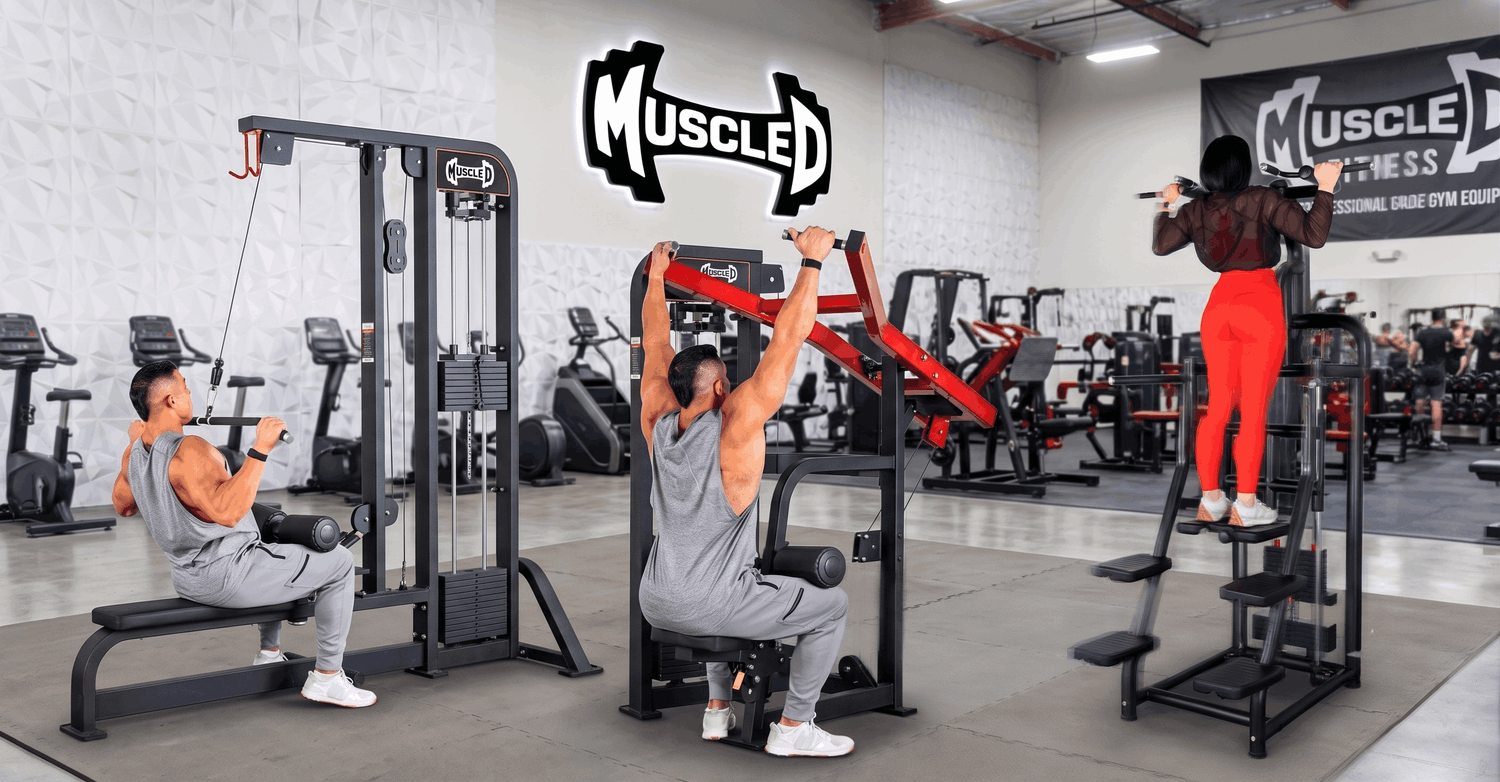
When it comes to carving out a powerful, V-tapered back, two heavyweight movements dominate the fitness landscape: the Pull-Up and the Lat Pulldown. Both are multi-joint, compound exercises that primarily target the latissimus dorsi (your lats), but they approach upper-body development from two entirely different biomechanical perspectives.
Are pull-ups truly the undisputed "king" of bodyweight movements, or does the lat pulldown offer advantages that can't be replicated on a bar? Let's dive into the scientific research, break down the biomechanics, and explore how to use Muscle D Fitness's premium equipment to maximize your back gains.
The Biomechanical Breakdown: CKC vs. OKC
To understand the core difference between these two staples, we have to look at kinetic chains:
- The Pull-Up is a Closed Kinetic Chain (CKC) exercise. In a CKC movement, your hands are fixed to an immovable object (the bar), and your entire body moves through space.
- The Lat Pulldown is an Open Kinetic Chain (OKC) exercise. Here, your body remains anchored and stationary while your hands pull a free-moving resistance (the bar or levers) toward you.
What Science Says: A landmark electromyography (EMG) study published in the Journal of Strength and Conditioning Research (Youdas et al., 2010) demonstrated that pull-ups elicit significantly higher overall core and abdominal activation compared to open-chain pulldowns. Because your lower body hangs free during a pull-up, your rectus abdominis and deep stabilizing muscles must fire aggressively to prevent your torso from swinging.
The Pull-Up: Unmatched Functional Power
The traditional pull-up is an incredible test of relative strength — how well you can control your own body weight against gravity. However, its greatest benefit is also its biggest barrier: many lifters lack the baseline strength to execute a strict, full-range-of-motion pull-up, often leading to kipping, shortened reps, or shoulder impingement.
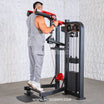
The Muscle D Solution: The Vogue Assisted Chin Dip
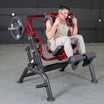
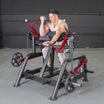
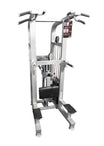
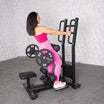
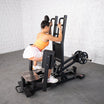
To reap the superior neuromuscular benefits of the closed kinetic chain without being limited by your current body weight, the Vogue Assisted Chin Dip machine is a game-changer.
- Why It Works: This machine features a counterbalanced knee pad that offsets a portion of your body weight. As you get stronger, you simply decrease the weight on the selectorized stack until you are pulling 100% of your own weight.
- The Design Advantage: Engineered with multiple ergonomic handle angles, the Vogue machine allows you to shift from a wide pronated (overhand) grip to a neutral (palms facing) grip. This reduces strain on the rotator cuff while ensuring your lats get a deep, fully engaged stretch at the top of the movement.

The Lat Pulldown: Precision Isolation and Hypertrophy Volume
While pull-ups are fantastic for building raw relative strength, the lat pulldown is arguably superior for pure bodybuilding hypertrophy (muscle growth). Why? Because it offers unparalleled stability and load control.
By anchoring your thighs under a pad, you eliminate the need to balance your core. This allows you to mindfully isolate the lats, push past failure safely, and easily adjust the weight for drop sets or high-volume training.
Depending on your structural biomechanics, Muscle D Fitness offers two distinct ways to execute the lat pulldown:
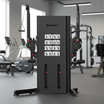
1. The Cable Approach: Classic V2 Lat Pull / Low Row Combo
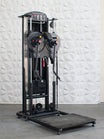
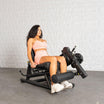
If you prefer a traditional, free-moving cable pathway, the Classic V2 Lat Pull / Low Row Combo provides the ultimate versatile training experience.
- The Science behind Cable Mechanics: Research investigating grip variations (Lusk et al., 2010) confirmed that a pronated (overhand) grip maximizes latissimus dorsi recruitment compared to a supinated (underhand) grip. Using the Classic V2's long pulldown bar allows you to seamlessly test various grip widths. Furthermore, because it utilizes a high-grade pulley system, the resistance profile stays completely smooth and continuous throughout both the concentric (pulling) and eccentric (lowering) phases.

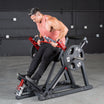
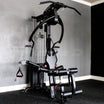
2. The Lever Approach: Classic V2 Selectorized Seated Lat Pull
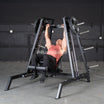
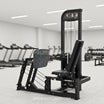
For those looking to maximize mechanical tension and completely isolate the upper back without relying on cable stabilization, a selectorized lever machine is the gold standard. The Classic V2 Seated Lat Pull Machine offers a highly specialized, lever-style alternative.
- The Biomechanical Advantage: Unlike a cable that pulls strictly vertically, the diverging lever arms of this machine mimic the natural, arcing musculoskeletal movement of the human shoulder joint. A study published in the Journal of Human Kinetics analyzed back activation and found that machine-guided, divergent paths allow for a cleaner contraction at the bottom of the movement, reducing auxiliary recruitment of the biceps and shifting the tension directly onto the lower lats and teres major.

Head-to-Head Comparison
| Feature | The Pull-Up (Vogue Assisted Chin Dip) | The Lat Pulldown (Classic V2 Series) |
|---|---|---|
| Kinetic Chain | Closed (Body moves around a fixed point) | Open (Weight moves around a fixed body) |
| Core Engagement | High (Requires abdominal stabilization) | Minimal (Torso is anchored) |
| Hypertrophy Focus | Great for overall upper body density | Superior for isolating specific lat regions |
| Progression Style | Decreasing assistance over time | Increasing raw weight stack resistance |
| Safety Profile | Requires excellent shoulder mobility | Highly controlled; easily adjustable |
The Verdict: How to Program Both for Maximum Results
You don't have to choose between the pull-up and the lat pulldown — science suggests using both will yield the most symmetrical, powerful back development.
- Start with the Pull-Up for Strength: Kick off your back day on the Vogue Assisted Chin Dip. Because it is a closed-chain movement demanding heavy neurological recruitment, perform it early in your workout when your nervous system is fresh. Aim for lower rep ranges (5–8 reps) to build structural power.
- Finish with the Lat Pulldown for Hypertrophy: Once your stabilizing muscles are fatigued, transition to the Classic V2 Lat Pull / Low Row Combo or the Classic V2 Seated Lat Pull Machine. Here, you can safely chase the "pump" with higher volume (3–4 sets of 10–12 reps), utilizing drop sets to exhaust every remaining muscle fiber in your lats.
By combining the natural, functional mechanics of Muscle D's assisted pull-up options with the locked-in, high-tension design of their lat pulldown machines, you establish the perfect foundation for a wider, stronger back.
Scientific References
- Youdas, J. W., et al. (2010). Surface Electromyographic Activation of the Suprahyoid, Infraspinatus, Latissimus Dorsi, and Core Muscles During the Pull-Up and Chin-Up Exercises. Journal of Strength and Conditioning Research.
- Lusk, S. J., et al. (2010). Grip Width and Forearm Orientation Effects on Muscle Activity During the Lat Pulldown. Journal of Strength and Conditioning Research.
- Andersen, V., et al. (2014). Effects of Grip Width on Muscle Strength and Activation in the Lat Pull-Down. Journal of Strength and Conditioning Research.

Dejar un comentario
Todos los comentarios se revisan antes de su publicación.
Este sitio está protegido por hCaptcha y se aplican la Política de privacidad de hCaptcha y los Términos del servicio.